The New York Times Lawsuit Against Brave Highlights the Growing Conflict Between Web Search Indexing and AI Data Harvesting


The legal battle between major media publishers and search engine operators has entered a volatile new phase following a copyright infringement lawsuit filed by The New York Times against Brave Software. The legal action, lodged on November 2, targets Brave—the developer behind the privacy-focused Brave Browser and Brave Search—over allegations that the company harvested more than 30 billion web pages without clear attribution or publisher consent. According to the complaint, Brave systematically scraped this vast repository of content and monetized it by licensing access to major artificial intelligence developers, raising profound questions about the future of web scraping, intellectual property rights, and the operational boundaries of modern search engines.
At the core of the controversy is the Brave Search API, a product through which Brave commercializes its search index to enterprise AI entities. While traditional search engines operate on a reciprocal traffic model—crawling web pages to index them and subsequently driving human visitors back to publishers via referral links—commercial AI assistants utilize search indices quite differently. When an AI chatbot or automated assistant answers a user query requiring real-time information, it frequently bypasses traditional web browsing entirely. Instead, it relies on structured data packages purchased from index providers.

The New York Times lawsuit alleges that Brave provides these AI companies with pre-processed "LLM Context"—extracted page chunks and source metadata formatted precisely to satisfy the technical requirements of large language models. Consequently, AI systems can generate comprehensive summaries and direct answers using publisher content without sending traffic or advertising revenue back to the original creators. The Times’s complaint names prominent AI developers—including Anthropic, Perplexity, Mistral, xAI, and Cohere—as recipients of Brave’s index data, underscoring how deeply integrated secondary search providers have become within the generative AI supply chain.
The mechanics of web crawler detection and management have emerged as a pivotal technical battleground in this litigation. Website operators traditionally control which automated bots access their digital properties through the robots.txt standard, a protocol that relies on distinct user-agent names to permit or deny specific crawlers. Prominent AI developers, such as OpenAI and Anthropic, publicly disclose the user-agent strings for their respective web crawlers, enabling publishers to selectively block AI data harvesting while continuing to allow general search engine traffic.
However, Brave’s crawler presents a distinct administrative challenge for webmasters. According to documentation on Brave’s official help pages, the company’s crawler does not advertise a differentiated user-agent string. Brave has defended this practice by asserting that many major news publishers maintain policies that permit access exclusively to mainstream search engines like Google while blocking independent competitors. To circumvent potential blanket blocks from cautious publishers, Brave’s crawler reportedly aligns its access permissions with Googlebot’s behavior, indexing content only where Google is permitted.
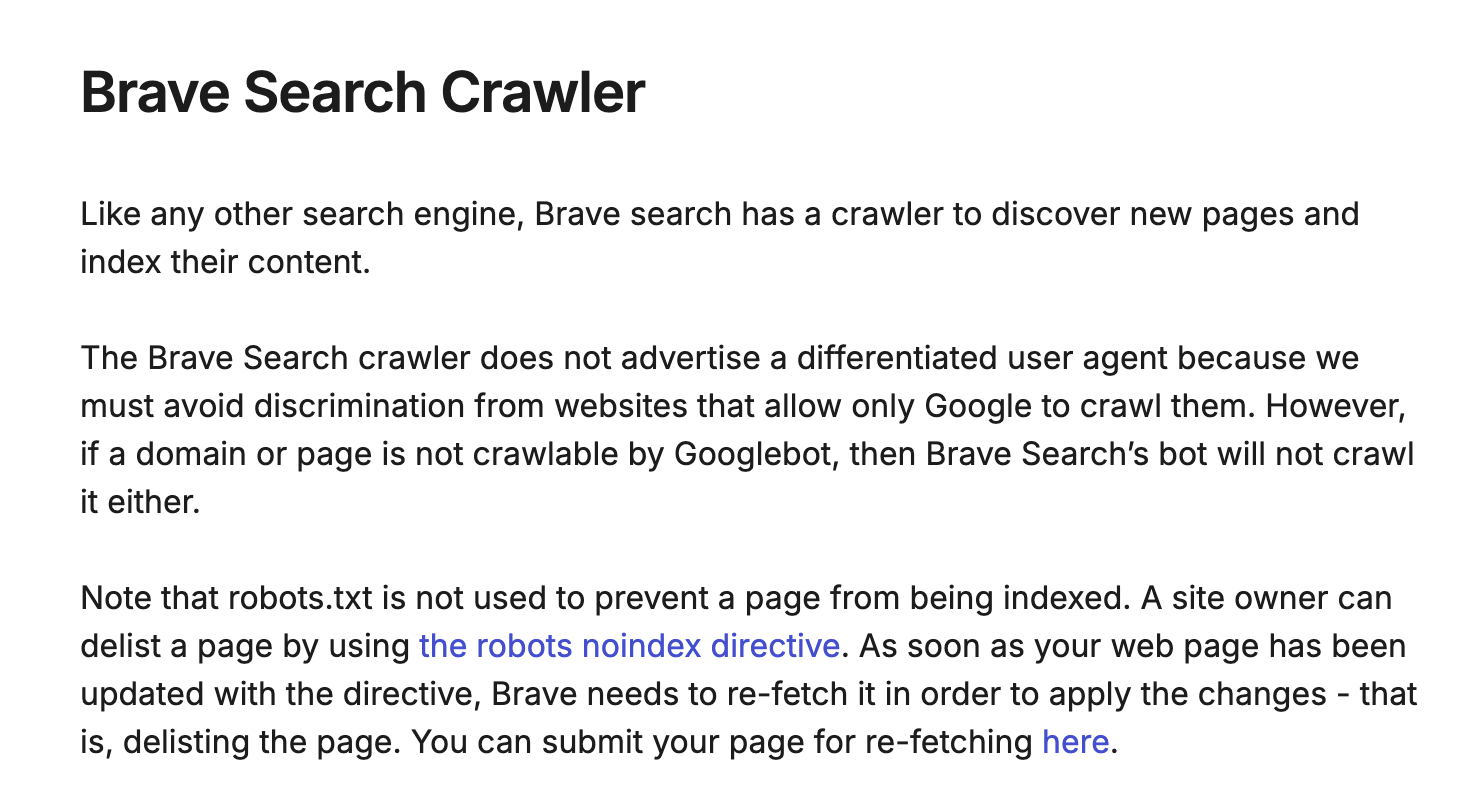
This technical design creates a binary dilemma for website administrators: a site must either allow both Google and Brave to access its content or block both entirely via the noindex meta tag, effectively sacrificing traditional search visibility to prevent index inclusion. The New York Times lawsuit explicitly condemns this lack of transparency, characterizing Brave’s refusal to deploy a recognizable user-agent name as a deliberate tactic to obscure its data collection activities from publishers.
The legal confrontation between Brave and major media outlets is part of a broader, escalating wave of copyright litigation targeting the intersection of search technology and generative artificial intelligence. The tension has been building for months across multiple legal fronts. In July 2026, media conglomerate News Corp filed a lawsuit against Brave following an earlier cease-and-desist exchange, accusing the search engine of concealing its crawlers to evade publisher detection and exploit copyrighted material for AI training. Concurrently, other major publications, including the Daily News, the Chicago Tribune, and the Orlando Sentinel, initiated separate legal proceedings against Brave on the same day as The New York Times filing, demonstrating a unified front among traditional news organizations.
Brave has historically defended its indexing practices as a foundational necessity of the modern internet. In previous legal defense arguments, the company maintained that comprehensive web crawling is an indispensable mechanical function required for the operation of any search engine. Brave representatives have argued that indexing publicly accessible web pages falls squarely within standard web navigation practices and does not inherently constitute copyright infringement. Nevertheless, the commercialization of that index specifically for generative AI training and retrieval-augmented generation represents a novel legal frontier that courts have yet to definitively resolve.
The implications of the ongoing litigation extend far beyond the immediate parties involved. As the boundary between search discovery and generative AI synthesis continues to blur, publishers are increasingly seeking legal precedents to establish ownership and monetization rights over their digital archives. If courts determine that search engine operators can legally harvest and license multi-billion-page indices to third-party AI developers without distinct publisher notification or opt-out mechanisms, the economic foundation of independent digital journalism could face severe structural disruption.
Conversely, a ruling against Brave could force search engine providers and AI infrastructure companies to implement granular, transparent crawler identification standards, granting content creators precise control over how their intellectual property is utilized in the artificial intelligence ecosystem. As the legal proceedings unfold, webmasters and digital publishers worldwide are closely monitoring the case to determine how they can safeguard their content in an increasingly automated digital landscape.